
Lender Readiness Implementation Pack
What lenders add to their LTA mandate to reduce risk and improve predictability of achieving COD and debt-service.
The problem lenders face
Lenders already require their Lender’s Technical Adviser to monitor engineering, procurement and construction progress. Few LTA mandates ask whether the project is becoming ready to operate: whether the people, organization, systems, procedures, interfaces and evidence needed to start the asset up and run it at the financing-case performance are developing in time. Those shortfalls usually surface at start-up, when they are slowest and most expensive to recover, and they fall on the first operating cash flows the debt depends on.
The difference is not whether readiness is achieved at the end, but whether it is shown to be maturing along the way. Low readiness maturity early in a project is normal. The risk is the absence of evidence that it is maturing.
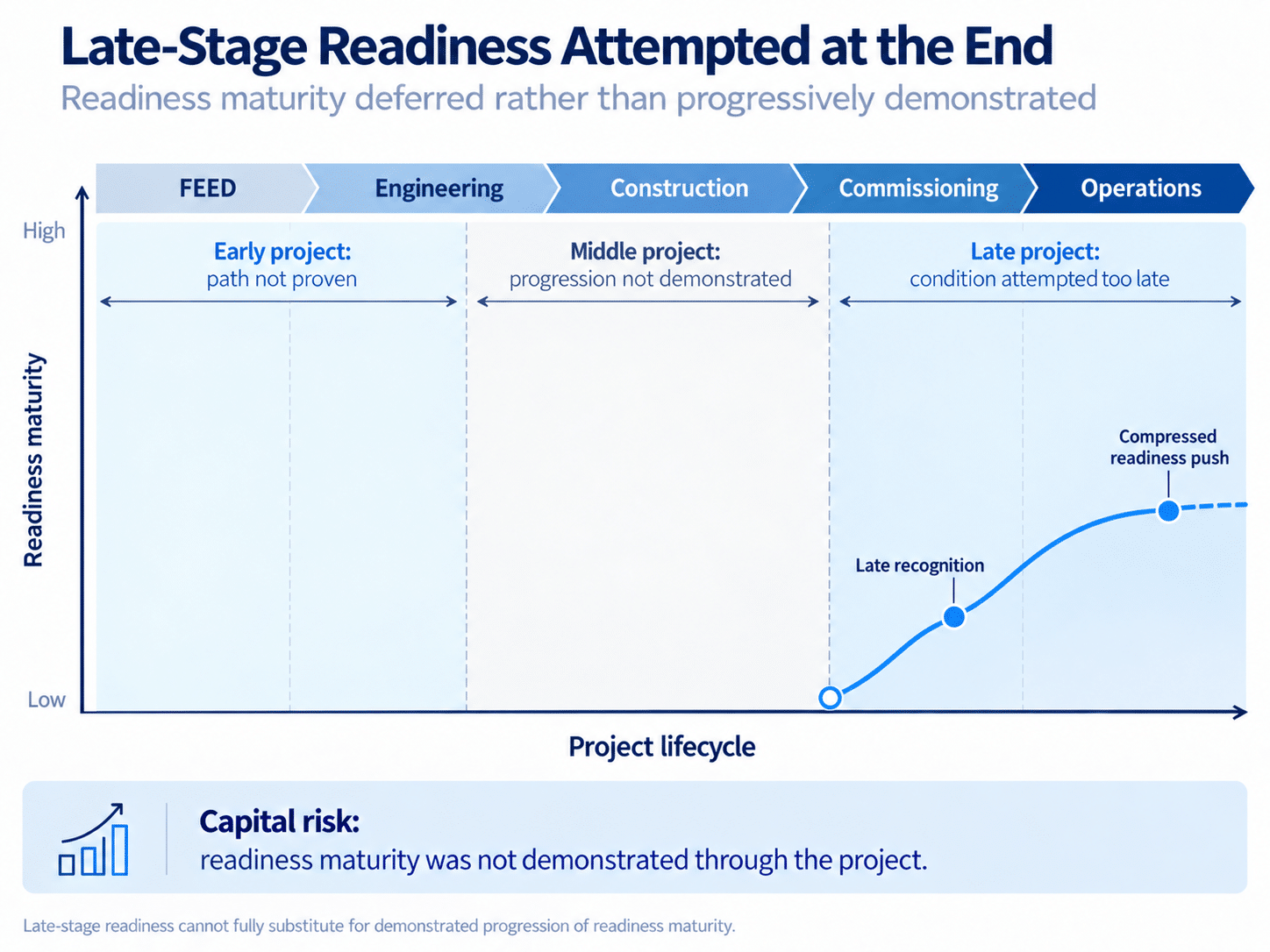
Readiness attempted at the end. The path is not proven early, progression is not demonstrated during construction, and the condition is attempted too late. A compressed readiness push rarely recovers the date.
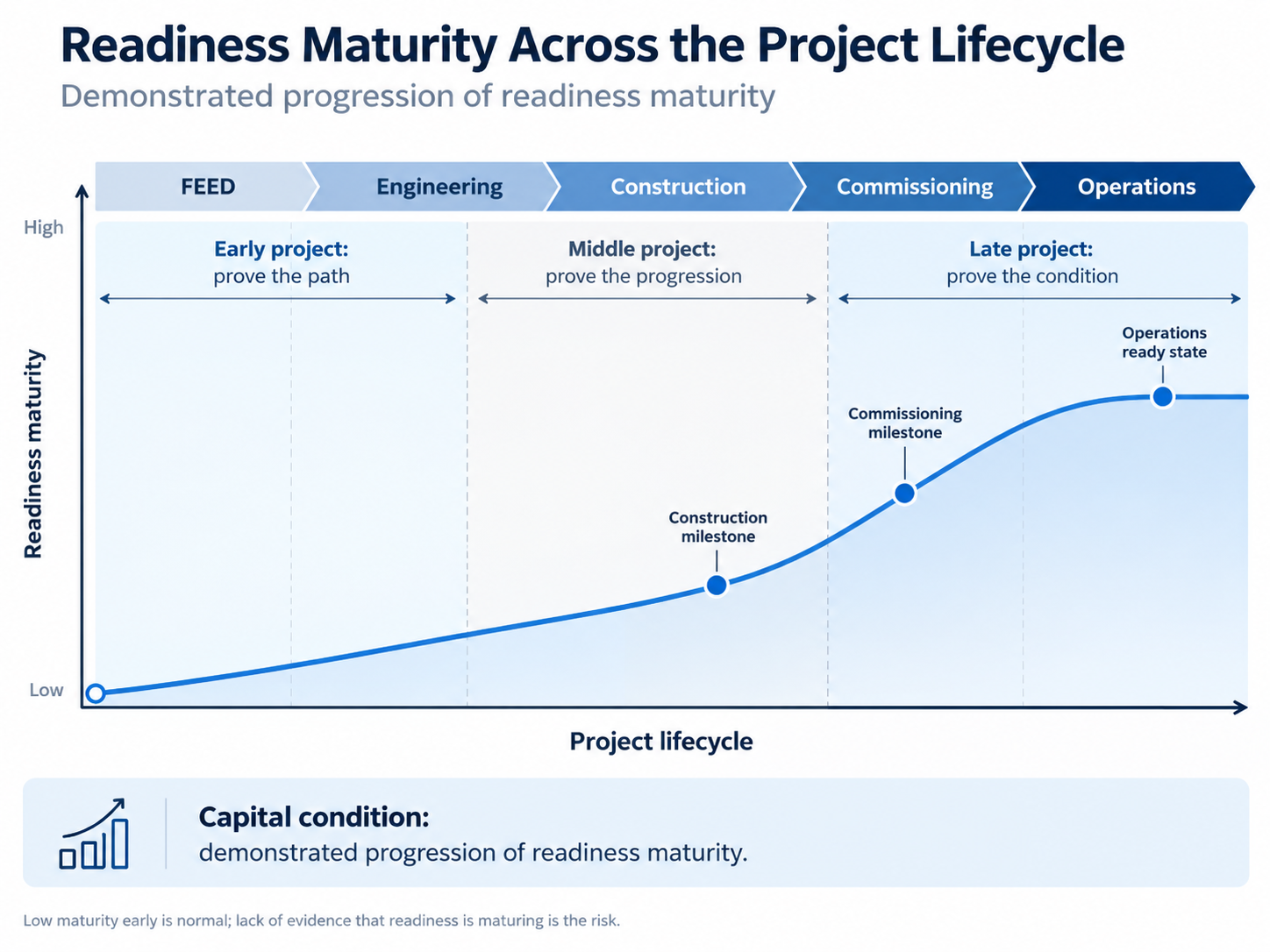
Readiness demonstrated progressively. The path is proven before financial close, progression is shown during construction, and the condition is demonstrated system by system before transition.
Why it matters to the lender
The second pathway gives the lender evidence at each capital-release decision instead of an assumption that the project will be ready on the day. That reduces transition risk and makes the commercial operation date more predictable: shortfalls are reported while there is still time to correct them, and the forecast date rests on demonstrated readiness rather than on construction completing.
What the lender adds to the LTA mandate
The pack adds a readiness mandate to the LTA’s existing appointment. Under it the LTA assesses the state of the project’s readiness conditions, the capabilities across people, organization, asset and systems and processes that must be in place for the planned transition, against readiness criteria, the defined requirements, thresholds or decision rules the evidence is judged against at each stage-gate before the project progresses or transfers operational control. Both are defined by the project under the ICxA Standards; the lender chooses which of them to link to capital release. Assessment starts before financial close.
Readiness here does not mean every item is complete. It means the capability required for the planned transition is sufficiently established and demonstrated, with material residual risks understood and controlled. A completed activity, such as operator training, is evidence of progress; the condition the lender cares about is whether the required competence has been shown to exist.
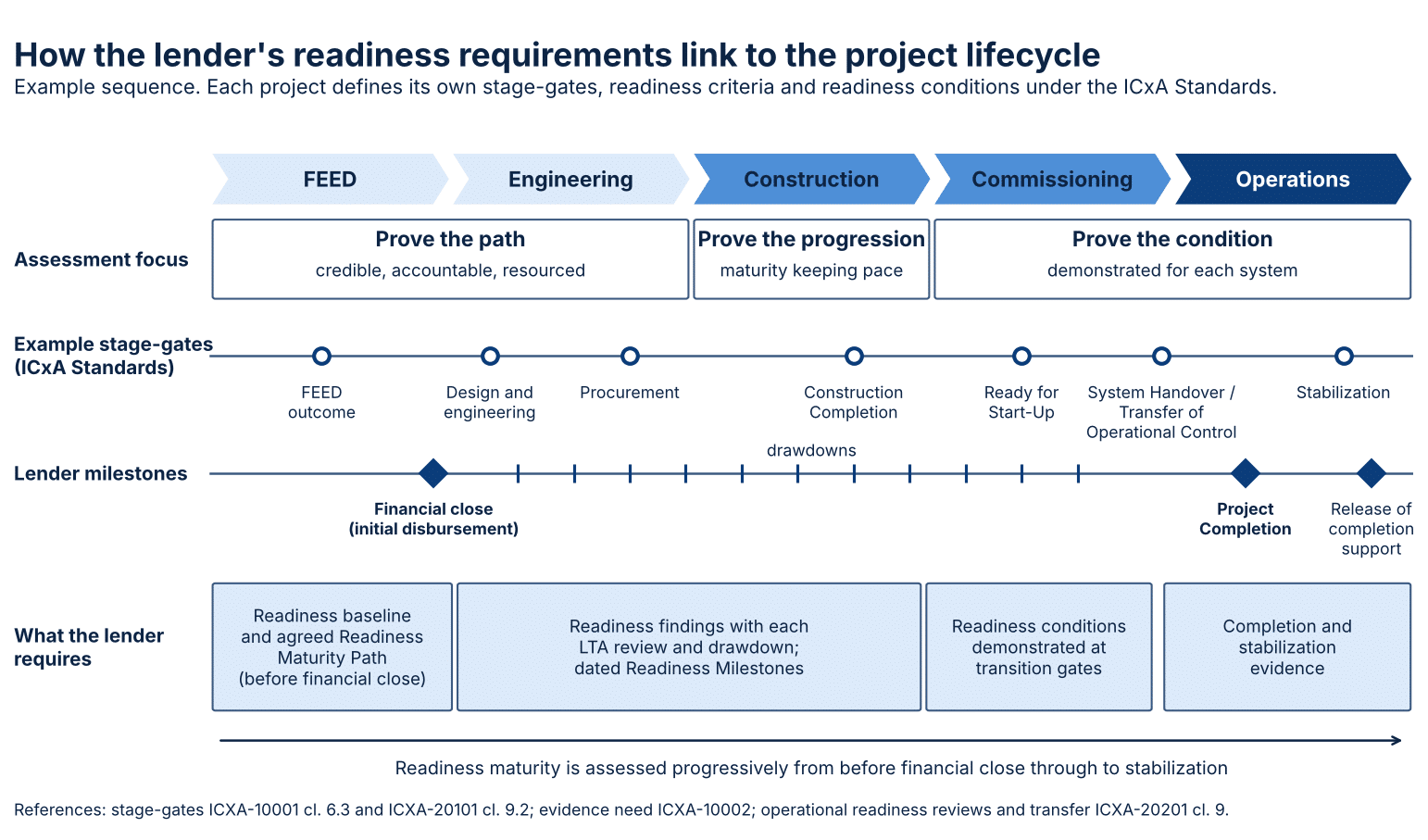
Example sequence. Each project defines its own stage-gates, readiness criteria and readiness conditions under the ICxA Standards.
How a lender uses it
- Select the readiness conditions that matter for the transaction.
- Append the LTA Scope Addendum to your LTA’s mandate.
- Have counsel incorporate the selected conditions into the financing documents.
- Receive readiness findings from your LTA at each review.
- Take those findings into account in capital-release decisions.
The Borrower and its contractors produce the evidence per the ICxA Standards, the LTA assesses it and reports within its mandate, counsel drafts, and the lenders decide.
How the LTA delivers the readiness mandate
The addendum defines what the lender requires to make informed readiness decisions on the release of capital. An LTA may build internal capability to fulfil the readiness mandate, or engage an ICxA Operating Partner. Either way the LTA remains responsible to the lender under its appointment.
What goes into the financing documents
Counsel selects the readiness conditions the lenders want to link to capital release and adapts the drafting: typically a readiness baseline and an agreed Readiness Maturity Path before financial close, continuing undertakings on evidence access, reporting and material change, a readiness statement with each drawdown, dated Readiness Milestones, readiness conditions at transition stage-gates, and readiness items in the completion test and the release of completion support. Lenders decide on any unmet requirement under their existing provisions. Start-up and transfer of operational control remain the Borrower’s and operator’s decisions.
What you receive at each review
A separately identifiable readiness section in the LTA’s report that answers six questions:
- Is readiness maturity progressing as required for this stage?
- Which material readiness conditions are behind their required state, unsupported by evidence or deficient?
- What could affect the planned transition or operating assumptions?
- What changed since the previous review?
- Which capital-release conditions have or have not been demonstrated?
- What actions or lender decisions are required?
The LTA distinguishes a confirmed deficiency from missing evidence and from a condition not yet due, and states the confidence the available evidence supports. There is no score, and the LTA does not certify that the project is ready or recommend whether to fund.
The Lender Readiness Pack
Three documents give a lender what it needs to add the readiness mandate, and they are free to download and review. Version 1.1, November 2026. The drafting in the conditions schedule is illustrative and should be settled by transaction counsel.
LTA Scope Addendum
What the lender requires its LTA to assess and report on readiness, with definitions, the reference framework, deliverables, competence and the readiness criteria in Schedule 1.
Readiness Conditions Schedule
Fifteen readiness conditions a lender can link to capital release, each stated by reference to the ICxA Standards, with illustrative drafting for counsel.
Worked Example
A fictional, completed financing told from the lender’s side: what it asked for, what it received, the decisions it took, and how readiness findings supported capital release.
Terms of use
Anyone may download, read and evaluate the pack internally free of charge. Commercial use requires ICxA Corporate Membership at any tier. Commercial use includes a lender incorporating these conditions or this scope into financing documents or an LTA mandate, an adviser using the pack in a paid engagement, and use in any product or service offered to others. Publicly stating that an assessment, mandate or service is aligned with the ICxA Standards is reserved for ICxA members.
Try it on one project first
A lender can evaluate the approach on a project already in its portfolio without changing the financing documents: ask for a readiness baseline against the addendum’s criteria and compare it with what current reporting tells you. A project with at least six months to first start-up works best.
Questions lenders ask
Is our LTA already doing this?
Rarely. LTA mandates are built around engineering, procurement and construction: progress, cost, schedule, change, and the completion and performance tests. Whether the project’s readiness conditions are maturing in time to achieve COD and support debt service is usually left as an afterthought, so it is not assessed or reported until start-up.
How is the readiness mandate different from the existing LTA mandate?
The existing mandate asks whether the asset is being built as planned. The readiness mandate asks whether the project will be able to start it up and run it as the financing case assumes: whether systems completion is organized and evidenced system by system, whether the operating organization is developing its people, organization, asset and systems and processes in time, and whether the governance overseeing the transition from construction to operations is in place. That second question is the one most mandates leave out, and where it is added it is additional scope.
Who supplies the evidence?
The project, in accordance with the ICxA Standards, which define the roles and responsibilities for producing readiness evidence and the independence required for evaluating and authorizing it: evidence owners for systems completion, the operational readiness role and receiving operational authority, an independent Outcome Auditor and an Outcome Director. The LTA assesses that evidence and the project’s decision records; it does not produce evidence or take part in the project’s readiness decisions.
How is this applied before construction begins?
Before financial close the question is whether the path to readiness is proven, not whether readiness has been achieved. As the two figures above show, low readiness maturity early is normal; what the lender needs to see is a credible, accountable and resourced path, set out in a Readiness Maturity Path agreed before initial disbursement, against which progression can then be demonstrated.
What if the project is already under construction?
The LTA establishes a baseline at the current stage and a path for the remaining stages. Conditions can be introduced by agreement, for example at a refinancing, amendment or waiver; otherwise the readiness mandate runs as reporting under the existing appointment.
What role do the ICxA Standards play?
They provide the framework the readiness mandate is fulfilled against: the stage-gates, the evidence each requires, the roles and independence for evaluating and authorizing it, systems completion, operational readiness, and transfer of operational control. Each project defines its own stage-gates, readiness criteria and readiness conditions under the Standards, and the LTA assesses the project against them.
Can the project’s existing records be used as evidence?
Yes, where they meet the evidence requirements of the ICxA Standards for the stage-gate concerned. A record that only shows an activity was completed, such as training attended or a procedure issued, supports a readiness condition only where it also shows that the capability exists. Where the LTA’s own earlier work already covers a readiness condition, it is cited rather than repeated.
What happens if evidence is missing?
The LTA reports that it has insufficient evidence to conclude on the condition’s state, with the history of its requests. That is not a finding of technical failure, and an asserted state without supporting evidence is not treated as demonstrated.
What happens if readiness falls behind?
The LTA reports it with the potential consequence for the transition and operating assumptions and, where a capital-release condition is affected, refers it to the lenders. The lenders decide what to do under their existing provisions.
Which findings affect funding?
Only those linked to conditions the lenders selected in the financing documents. Everything else is reported for information.
Does this require software, certification or an ICxA-appointed assessor?
No software and no certification. ICxA does not appoint assessors: the LTA may deliver the readiness mandate with its own capability or by engaging an ICxA Operating Partner. Commercial use of the pack is covered by the terms of use.
What experience should the people assessing readiness have?
Commissioning experience is not enough. Assessing readiness requires leadership experience of taking capital projects through the transition from construction to operations and of the governance that oversees it. ICxA credentials help a lender evaluate this: the readiness lead should hold the Commissioning Project Manager (CxPM) or Operational Readiness Strategist (ORS) credential or higher, and ideally the Outcome Auditor (OA) or Outcome Director (OD) credential.
What additional work and cost should be scoped?
Ask the LTA to price the readiness baseline before financial close, the readiness section at each review, reviews before transition stage-gates, completion and stabilization, and reassessment after material change.
What does this give the lender, and what remains uncertain?
It reduces transition risk and makes the commercial operation date more predictable, because readiness shortfalls are reported while there is time to correct them and each capital-release decision rests on evidence that readiness is maturing. It cannot establish that start-up will succeed or that the asset will perform as assumed, and the pack makes no claim of predictive accuracy or cost saving.
Next steps
Talk to ICxA
Discuss adding a readiness mandate to a current or upcoming financing.
Get the pack
Download the LTA Scope Addendum, the Readiness Conditions Schedule and the Worked Example.
Use it on a transaction
Commercial use, including in financing documents and LTA mandates, requires ICxA Corporate Membership at any tier.